Terengganu-based developer Ting Mee Group started as a hardware store called WNT Sdn Bhd in 1978. When the oil and gas industry was booming, its founder Wong Tow Leong saw opportunities in housing renovation and set up Ting Mee Construction Sdn Bhd in 1992.
In the 2010s, the company diversified into property development and established Ting Mee Development Sdn Bhd, says Ting Mee Group managing director Wong Nian Foong, who is Tow Leong’s son.
At the time, most of its works were small residential and commercial projects on pockets of land in the outskirts of Terengganu. The group has a land bank of 125 acres, mostly in Terengganu.
Some of its completed projects are Rose Villa bungalows (2013), Taman Sri Putra terraced houses (2011) and Taman Medina Sari single-storey semi-detached houses (2020).

Eyeing bigger things
Nian Foong, when he joined the company, was looking to grow the business. “At the time, I was planning our company’s direction and questioned why we didn’t have strategic land in our portfolio,” he recalls, adding that most of the company’s land bank are pocket land in the outskirts of town.
As luck would have it, he chanced upon a site while at a project roadshow at Mesra Mall in Kerteh. “I was looking out of the window and saw the land and thought to myself, ‘why don’t we choose this land?’
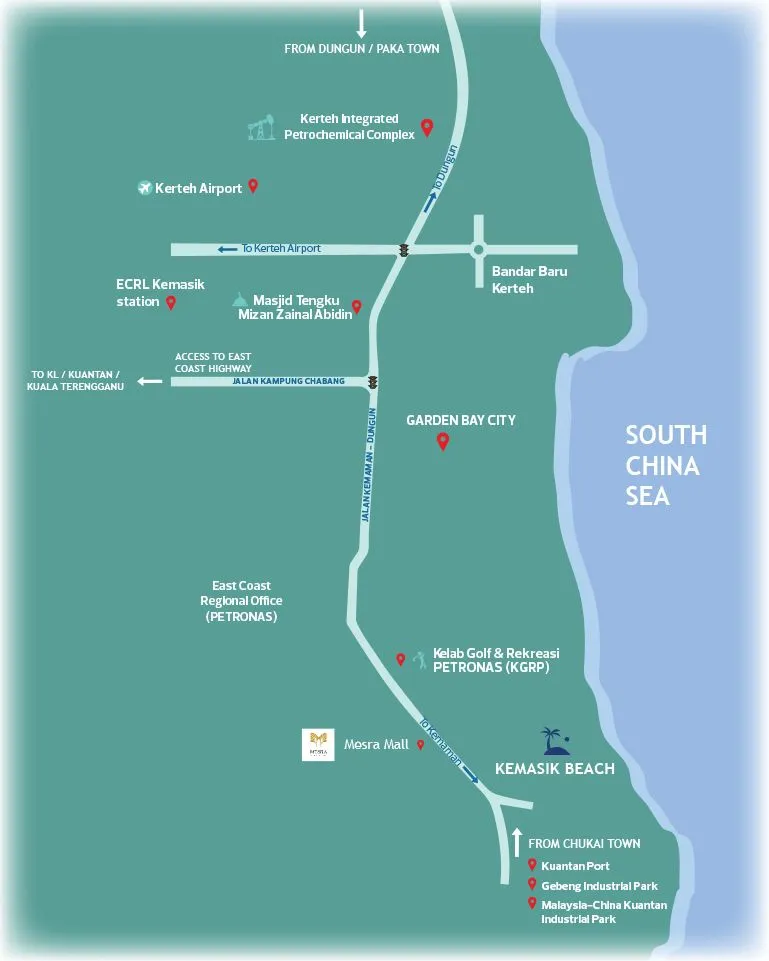
Because of the site’s highly strategic location near the major employment hub of the Kerteh Integrated Petrochemical Complex and key amenities such as the Petronas East Coast Quarters, Mesra Mall and the PETRONAS Golf Club, the development is well-positioned to serve higher-income professionals and families. We recognise that this project goes far beyond a conventional development. It is a once-in-a-generation opportunity to shape a new destination for Terengganu. Then, I engaged with the state government and found out that it had an open tender for the land.”
Ting Mee Land Sdn Bhd was established in 2019 to tender for the site, which it won.
The site, strategically located along the main road, had been leased by the state government to a few oil and gas companies — including ExxonMobil, Shell and Petroliam Nasional Bhd (PETRONAS) — since the 1980s to build quarters for their oil and gas workers. When PETRONAS completed its Rantau Petronas Housing development, it relocated its staff there and the site was left vacant for two decades.
According to Nian Foong, the state government had been searching for developers to collaborate with to develop the site. “Over the 20 years, about 10 developers attempted to tender for the land but were unable to resolve underlying issues.”
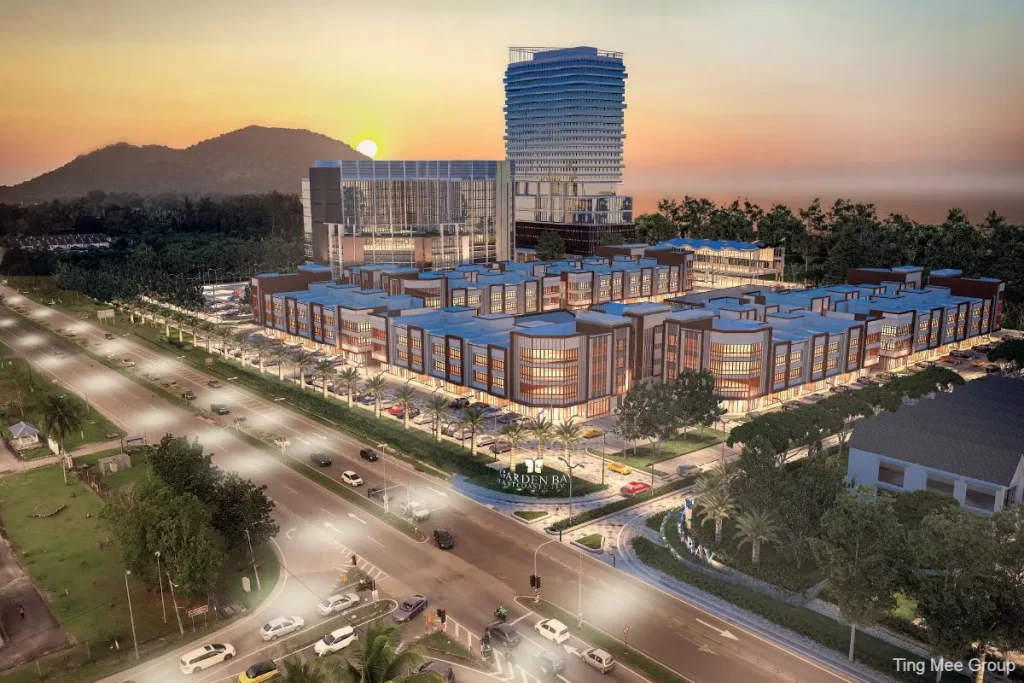
Garden Bay City
Ting Mee Group is now ready to unveil its master plan and expects to officially launch Garden Bay City in 1Q2026.
Growing up, Nian Foong noted the lack of key amenities and wanted to contribute meaningfully to his home state. “As someone born and raised in Terengganu, I deeply understand the challenges of living in areas lacking healthcare facilities, lifestyle hubs, quality homes, hotels and modern conveniences. Instead of complaining about the shortcomings, I chose to provide solutions.
“Garden Bay City will stand as the new landmark of southern Terengganu — an inspired destination to live, heal, play and connect with nature,” says Nian Foong.
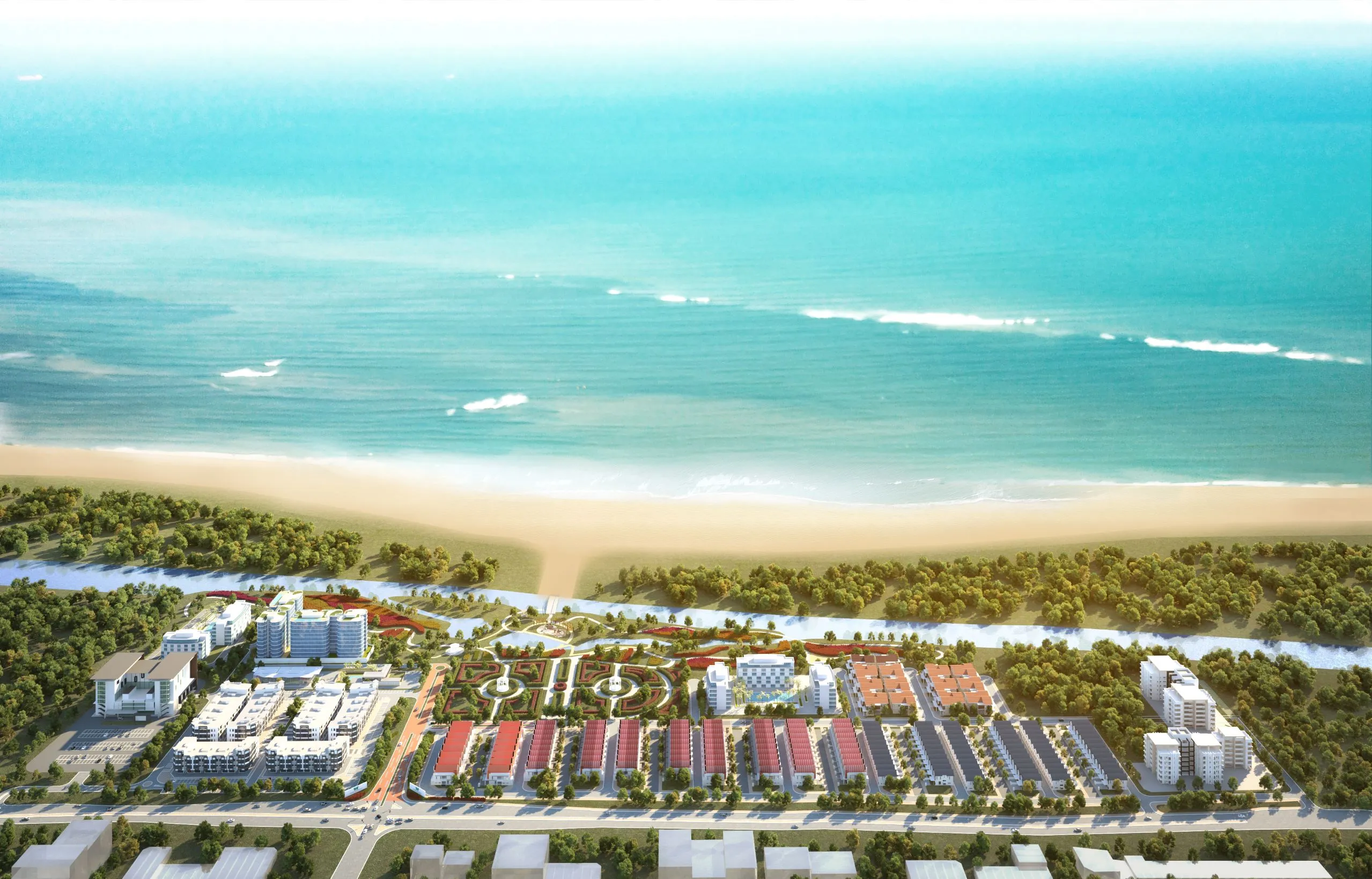
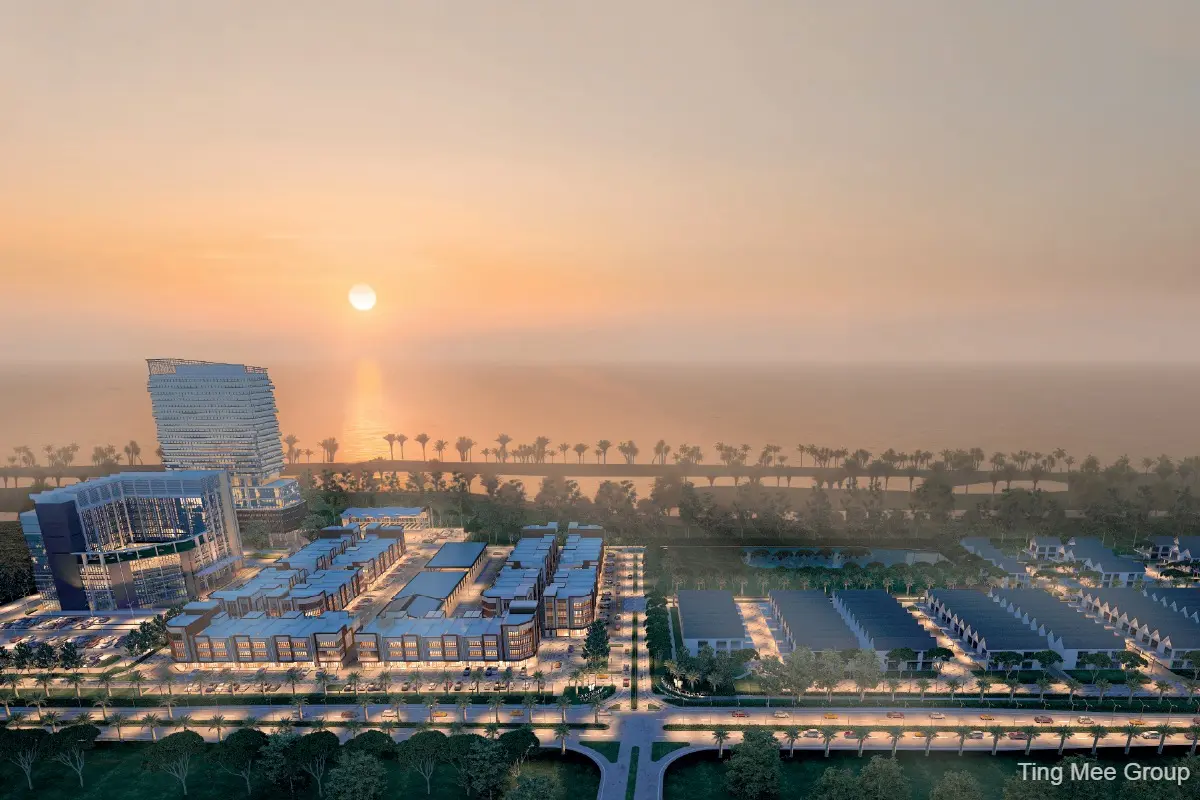
The township, which will have a gross development value (GDV) of RM700 million, will be developed in five phases and is targeted to be completed by 2032. It will comprise 214 landed residential units, 235 affordable housing units, 72 commercial retail lots, a 200-bed private healthcare centre, a hotel and serviced apartments, as well as a central park.
In the first phase will be the RM110 million commercial hub called The Walk, which will comprise 72 two- to four-storey retail units. Ten corner lot units will be kept by the developer and leased to suitable tenants while the remaining units will be sold at prices starting from RM1.4 million.
The Walk will feature 72 two- to four-storey retail units that are priced from RM1.4 million. Corner units are not for sale and are retained by the developer. (Photo by Ting Mee Group)
“The Walk will take three to four years to complete. We have already secured a few convenience stores and a supermarket as tenants for the corner lots,” explains Nian Foong.
With a GDV of RM105 million, phase two, called Gloris, will comprise 150 two-storey terraced garden homes that will be developed in three sub-phases. The first sub-phase will comprise 50 units with land areas of 20 ft by 70 ft and 20 ft by 75 ft and built-ups ranging 1,700 to 2,500 sq ft. The selling price starts from RM550,000.
“It is called a garden home because there is a courtyard in the middle of the house that can be used as a garden. When we did the studies, we found that the locals wanted an extra piece of land for outdoor use but terraced houses do not offer that. At the same time, terraced houses also have issues when it comes to natural lighting. So, the courtyard can help to light up the house naturally.”
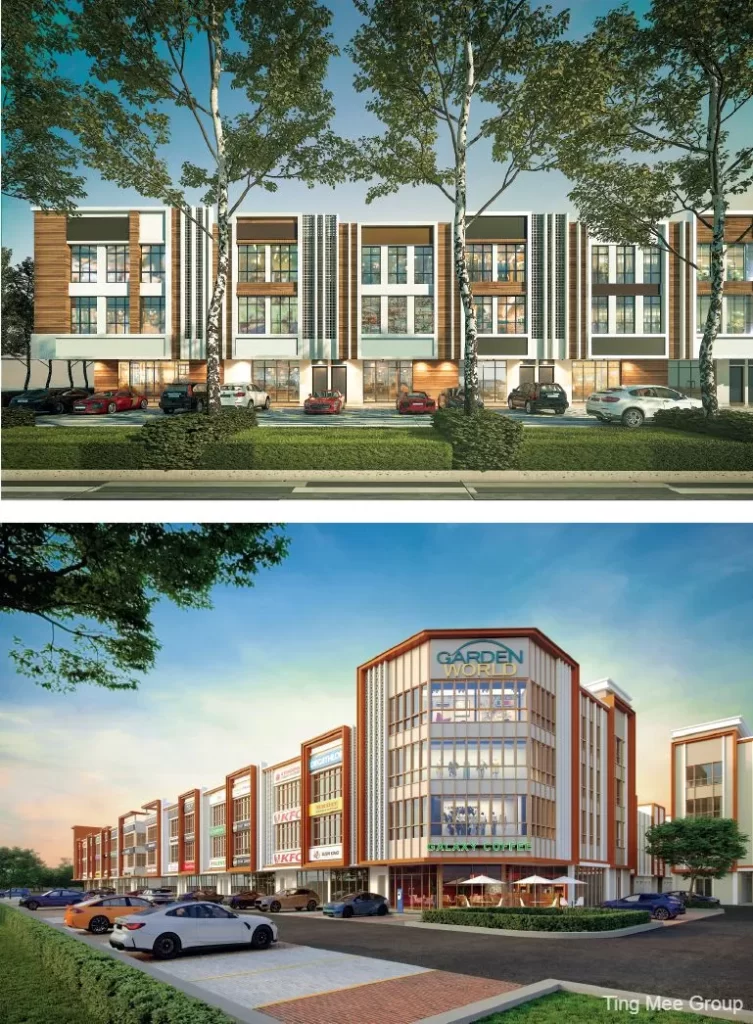
The architecture follows modern contemporary principles with Eastern–Japanese influences, resulting in minimal ornamentation, clean lines, functional spaces and natural light. Simple geometric forms are carved to improve shading, ventilation and visual balance, and the pitched roof enhances airflow and reduces heat gain.
As for the other components of the master plan, the developer is looking for an operator for the hospital building. The hospital will not only serve the people of Kerteh but also the population in neighbouring areas such as Dungun and Kemaman. According to Nian Foong, there are no private hospital in these areas.
Another unique factor of the township is its location in nature, he says. “Through numerous site visits and detailed studies, we discovered that a river, a mountain and the sea all converge next to the site. Rather than developing simple terraced houses, we saw an opportunity to create an integrated township that maximises these natural assets.
“We want to beautify the river, and build a bridge that connects the township to the beach, so it can be a tourist spot.”
Outlook
According to Nian Foong, there is currently an undersupply of housing in Terengganu. “The state is rich in natural resources, with oil and gas, and has pristine coastlines and beautiful islands. With a population of 1.2 million people, the current supply only stands at 110,000 housing units. This indicates a significant undersupply in the market.”
He adds that the East Coast Rail Link (ECRL) will increase the demand for housing. “The upcoming ECRL station in Terengganu is expected to significantly benefit the local community, enhance regional connectivity and stimulate sustainable property demand. Traditionally, many young people leave the state for job opportunities in larger cities, yet, as they reach the age of 35 to 45, they often return and live close to their families. The ECRL will greatly improve convenience for them, making relocation back to Terengganu practical and appealing.”
“Within this context, Garden Bay City stands out as one of the most accessible and strategically positioned locations in the state — offering immediate access to the East Coast Highway, close proximity to the ECRL Kemasik station and excellent connectivity via major arterial roads.”